
Brazilian industry returns to growth with modest July gain
Brazil’s industrial output rose 0.2 percent in July, interrupting two months of contraction, according to IBGE. The data point to a mixed recovery, with durable goods and capital goods improving while intermediate goods slipped.
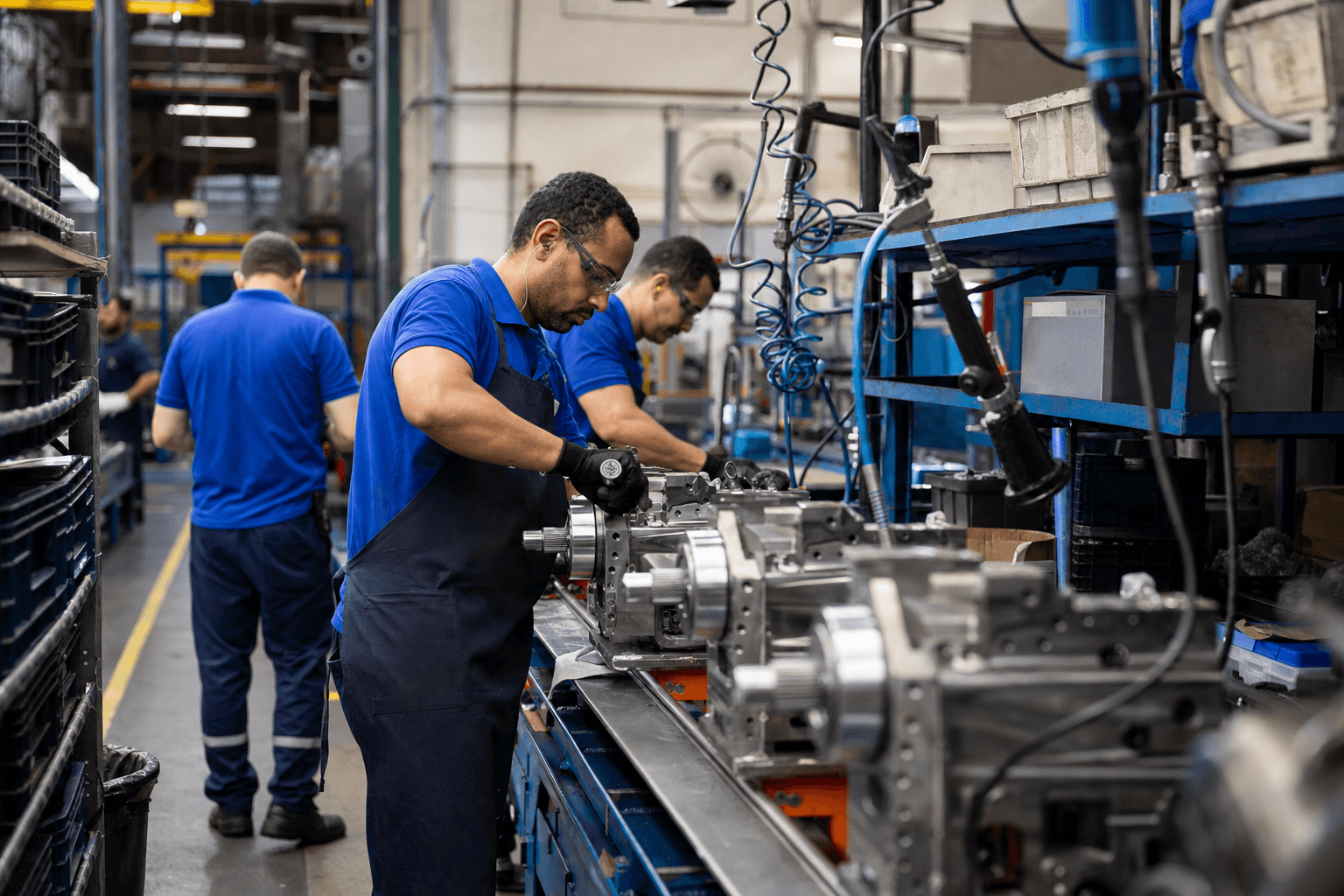
Brazilian industrial production edged up 0.2 percent in July compared with June, bringing a brief halt to two consecutive months of decline and giving manufacturers a modest positive signal in the middle of 2026.
The figures were published by IBGE, Brazil’s national statistics agency, in its monthly industrial survey. For international companies, IBGE data are among the key official references used to track the direction of the Brazilian economy, alongside indicators from the Central Bank and the Ministry of Development, Industry, Trade and Services.
The July result leaves Brazilian industry 1.1 percent higher so far in 2026. Over the 12 months through July, production was up 0.6 percent. That annualised measure, however, slowed slightly from the 0.7 percent recorded in the 12 months through June, suggesting that the sector is still struggling to build stronger momentum.
Compared with July 2025, industrial output was down 0.5 percent. The quarterly moving average, a measure used to smooth monthly volatility and identify the underlying trend, contracted 0.8 percent.
Durable goods and machinery lead the monthly rise
The July increase was not evenly distributed across the industrial base. Three of the four broad economic categories tracked by the survey expanded from June to July.
Durable consumer goods, a category that includes items such as vehicles, appliances and other longer lasting household products, recorded the strongest performance, with output up 3.2 percent. Capital goods, which include machinery and equipment used by companies to expand or maintain production capacity, rose 2.4 percent.
Semi durable and non durable consumer goods grew 0.5 percent. This group covers a wide range of products with shorter replacement cycles, often more closely linked to household consumption.
Intermediate goods were the exception, falling 0.2 percent in the month. This category includes inputs used in other production chains, so weakness there can matter for companies monitoring upstream demand, supplier conditions and industrial inventory cycles.
For investors, the split matters. A rebound in durable goods and capital goods can indicate improved confidence among consumers and businesses, but a decline in intermediate goods points to a more uneven manufacturing environment. The headline gain, while positive, was small.
Breadth improves, but the trend remains cautious
One encouraging detail in the IBGE release was the diffusion index, which measures how widespread growth was across the basket of products covered by the survey. In July, 69.6 percent of the 789 products surveyed posted gains from June.
That was the second highest reading of 2026, behind only March, when 80.6 percent of products showed positive performance. A higher diffusion index can indicate that growth is not concentrated in just a few sectors or product lines, although it does not by itself show the strength of each individual increase.
The broader picture is therefore mixed. Production improved in July, and the number of products showing gains was relatively high. At the same time, the sector remained below its level of a year earlier, the quarterly moving average declined, and the 12 month growth rate eased from the previous reading.
For foreign manufacturers, suppliers and investors, the data reinforce the need to look beyond the headline number. Brazil’s industrial sector contains several large and distinct markets, from automotive and machinery to consumer goods, chemicals, food processing and industrial inputs. Monthly changes can reflect shifts in domestic demand, export conditions, credit costs, inventories and sector specific production schedules.
Why this matters for companies entering Brazil
Brazil remains Latin America’s largest industrial economy, and even small movements in output can influence decisions on sourcing, distribution, local partnerships and capital expenditure. Companies selling machinery or production technology will pay particular attention to the 2.4 percent rise in capital goods, since that category is closely tied to corporate investment decisions.
Consumer facing companies may also take note of the 3.2 percent increase in durable goods, although one month of growth is not enough to establish a sustained recovery. The annual comparison, down 0.5 percent, is a reminder that industrial demand remains uneven.
For international businesses already operating in Brazil, the July figures suggest conditions are stabilising after two weaker months, but not yet accelerating strongly. For those considering market entry, the data provide a useful snapshot of a manufacturing sector that is still expanding modestly over the year, with pockets of strength and areas of caution.
If your company is assessing investment, partnerships or expansion opportunities in Brazil, connect with Brazil Business Club to discuss how these industrial trends may affect your strategy.
Doing business in Brazil?
Brazil Business Club connects investors and companies from around the world with the people and opportunities driving Brazil's economy. Tell us what you are looking for and we will help you take the next step.
Reported by the Brazil Business Club newsroom, with reference to Agência Brasil.