
Brazilian industry loses momentum as September output drops 0.8%
Brazil’s industrial production fell for the fourth time in five months, undershooting market expectations and signalling a weaker manufacturing environment. Extractive industries helped cushion the decline, but losses were broad across factories.
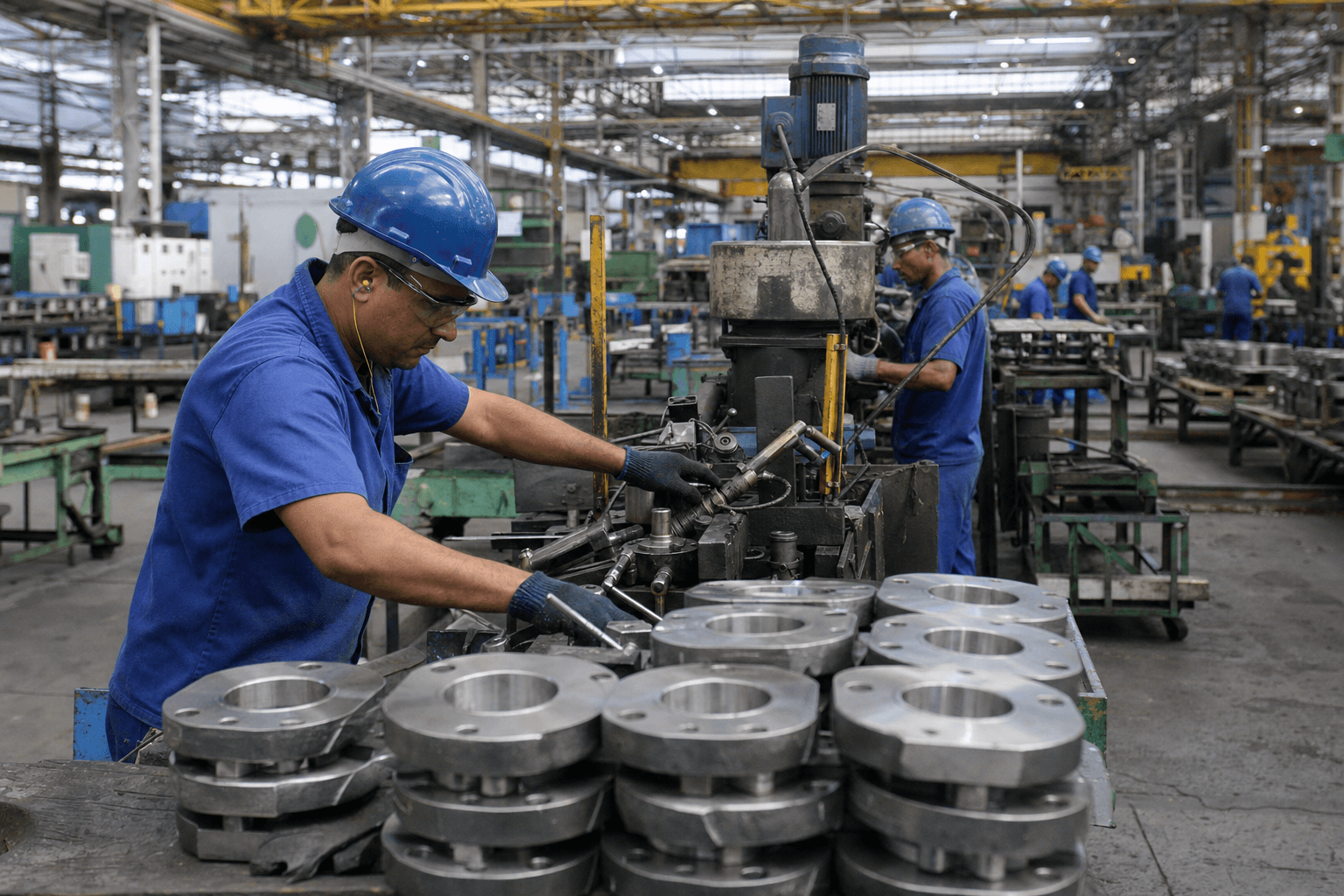
Brazil’s industrial sector entered the final quarter of 2026 with a weaker pulse, after factory output fell 0.8 percent in September from August, according to data released by IBGE, the national statistics institute.
The result matters for international manufacturers, suppliers, commodity buyers, and investors because Brazil’s industrial cycle cuts across several strategic sectors, from food processing and biofuels to machinery, oil, gas, and mining. The September reading marked the fourth monthly decline in five months, reinforcing signs that activity has slowed after a stronger start to the year.
IBGE’s Monthly Industrial Survey, known in Brazil as PIM, tracks physical production across industrial activities and is one of the country’s main indicators of factory performance. The September figure was weaker than expected. Brazil’s Ministry of Finance, through its Secretariat of Economic Policy, said the result came in below the median market forecast of a 0.4 percent decline.
A slowdown after early-year gains
The latest data show how quickly momentum has faded. Industrial output has accumulated a 4.1 percent drop over the last five months, almost erasing the 4.2 percent advance recorded in the first four months of 2026.
IBGE survey analyst André Macedo said the recent sequence points to “a clear slowdown in the pace of growth.” The monthly path has been uneven but mostly negative: production fell 1.0 percent in May, 1.6 percent in June, was flat in July, declined 0.7 percent in August, and then dropped another 0.8 percent in September.
Over the 12 months through September, industrial production was still up 0.2 percent. Even so, the level of output remains far from Brazil’s previous industrial high. IBGE said production is 16.5 percent below the record reached in May 2011, a reminder of the long-term challenge facing Brazilian industry after years of volatility, weak investment cycles, and uneven demand.
For companies assessing capacity, sourcing, or market entry, the September numbers suggest caution rather than contraction across the board. Brazil’s industrial base remains large and diversified, but the near-term direction has become less supportive, especially for businesses tied to domestic manufacturing supply chains.
Losses spread across most segments
The September decline was broad. Macedo described a “widespread pattern of declines” from August to September, with production falling in three of the four major economic categories monitored by IBGE and in 17 of the 25 industrial activities surveyed.
Capital goods, which include machinery and equipment and are often watched as a gauge of business investment, fell 1.9 percent. Semi-durable and non-durable consumer goods declined 1.2 percent. Intermediate goods, which are inputs used by other industries, slipped 0.7 percent. Durable consumer goods were the exception, rising 0.7 percent in the month.
Among industrial activities, the heaviest negative contribution came from coke, petroleum products and biofuels, down 4.2 percent. Food products also weighed on the overall result, with output falling 1.7 percent.
A key factor was the agricultural link to industry. Macedo said lower production of ethanol and sugar played an important role in the September decline. “It is worth noting that these sectors were affected by a decline in sugarcane processing, largely due to heavier rainfall,” he said.
That detail is important for foreign investors because Brazil’s industrial data often reflect conditions beyond factory floors. Weather, harvest timing, logistics, and commodity processing can all affect output in food, fuel, and export-linked supply chains.
Extractive industries soften the fall
Not all major segments moved lower. Extractive industries rose 1.7 percent in September and provided the largest positive contribution to the headline industrial result. According to Macedo, the main drivers were higher extraction of crude oil, natural gas, and iron ore.
That split illustrates a familiar feature of Brazil’s economy. Manufacturing and processing activities may weaken while resource-linked industries continue to benefit from production schedules, export demand, and large-scale energy and mining operations.
Compared with September 2025, total industrial production fell 2.5 percent, the sharpest year-on-year decline since March 2024, when output was down 2.9 percent. IBGE noted two factors behind the annual comparison: September 2026 had one fewer business day, and the comparison base was high because industrial production had risen 2.0 percent in September 2025.
For international companies, the message is mixed. Brazil’s industrial sector is not in free fall, but the breadth of September’s decline and the reversal from early-year gains point to a more difficult operating environment. Investors should watch whether durable goods resilience and extractive sector growth can offset weakness in processing industries, food, fuels, and capital goods in the months ahead.
Companies looking to invest in Brazil, assess suppliers, or understand sector opportunities can connect with Brazil Business Club for market intelligence, introductions, and practical support.
Doing business in Brazil?
Brazil Business Club connects investors and companies from around the world with the people and opportunities driving Brazil's economy. Tell us what you are looking for and we will help you take the next step.
Reported by the Brazil Business Club newsroom, with reference to Agência Brasil.