
Brazil unemployment falls to 5.3% as jobs hit record high
Brazil’s labour market reached a new high in the quarter through July, with 103.3 million people employed. The gains point to stronger household income, although informal work is expanding faster than formal hiring.
Brazil’s labour market is sending a strong signal to companies watching consumer demand, wage costs and capacity constraints in Latin America’s largest economy.
The unemployment rate fell to 5.3% in the three months to July, down from 5.8% in the quarter ended in April and below the 5.6% recorded in the same period of 2025, according to data released on Thursday, Aug. 27, by IBGE, Brazil’s national statistics agency.
The number of people in work reached 103.3 million, the highest level since the current series of the Continuous National Household Sample Survey, known in Portuguese as Pnad Contínua, began in 2012. The survey is one of Brazil’s main gauges of employment, income and labour market conditions.
The number of unemployed people stood at 5.8 million, a decline of 503,000 from the previous moving quarter and 299,000 fewer than a year earlier.
A tighter labour market, but not evenly formal
For international employers and investors, the headline figure matters, but the composition of job creation deserves equal attention.
Private sector employment with a signed labour card, the formal contract known in Brazil as carteira assinada, remained broadly stable at 39.4 million people. That is also a record for the series. Formal labour contracts are central to Brazil’s employment system because they typically include social security contributions, paid holidays, severance fund deposits and other statutory protections.
The faster movement came outside that framework. Private sector employees without a signed labour card rose 3.6% over three months, adding 477,000 workers and reaching 13.8 million. As a result, the informality rate increased to 37.5% of the employed population, from 37.2% in the previous quarter. In absolute terms, 38.8 million workers were classified as informal.
Brazil’s total labour force also hit a record, at 109.2 million people. Part of that increase reflects a reduction in the number of people who had stopped looking for work, an important detail in a country where discouraged workers can materially affect headline unemployment.
Underuse of labour continues to fall
Broader indicators also improved. The composite underutilisation rate, which includes unemployed people, those working fewer hours than they would like, and people in the potential labour force, fell to 13%. That was 0.8 percentage point lower than in the previous quarter.
The number of underutilised workers declined to 14.9 million, a reduction of 819,000 in three months. The discouraged population, defined by IBGE as people who had given up searching for work, was 2.3 million. That group fell 9.7% from the prior quarter and 14.1% from the same period a year earlier.
For businesses, this suggests a labour market with more people participating and fewer workers on the sidelines. It also raises practical questions around recruitment, retention and wage planning, particularly in sectors competing for operational staff.
Income, sector shifts and the investment readout
Average usual real income was R$ 3,762, with no statistically significant change from the quarter through April. Compared with a year earlier, however, income was up 3.3%, from R$ 3,643.
The total real wage bill reached R$ 383.5 billion, a new record in the IBGE series. Over 12 months, it increased 4.1%, equivalent to an additional R$ 15.1 billion circulating through households. For consumer-facing sectors, that expansion in labour income is one of the most relevant indicators to monitor, especially alongside credit conditions and inflation.
Among industries, accommodation and food services was the only sector with a relevant quarterly change in earnings, with a 5.1% decline, or R$ 128. In the annual comparison, other services recorded the strongest income growth, at 6.6%, followed by industry, at 4.7%. Domestic services income rose 4.1%, even though the number of people employed in that segment fell.
By job status, income for formal employees with a signed labour card rose 2.5% over the year. Domestic workers and self-employed workers each saw gains of 4.1%.
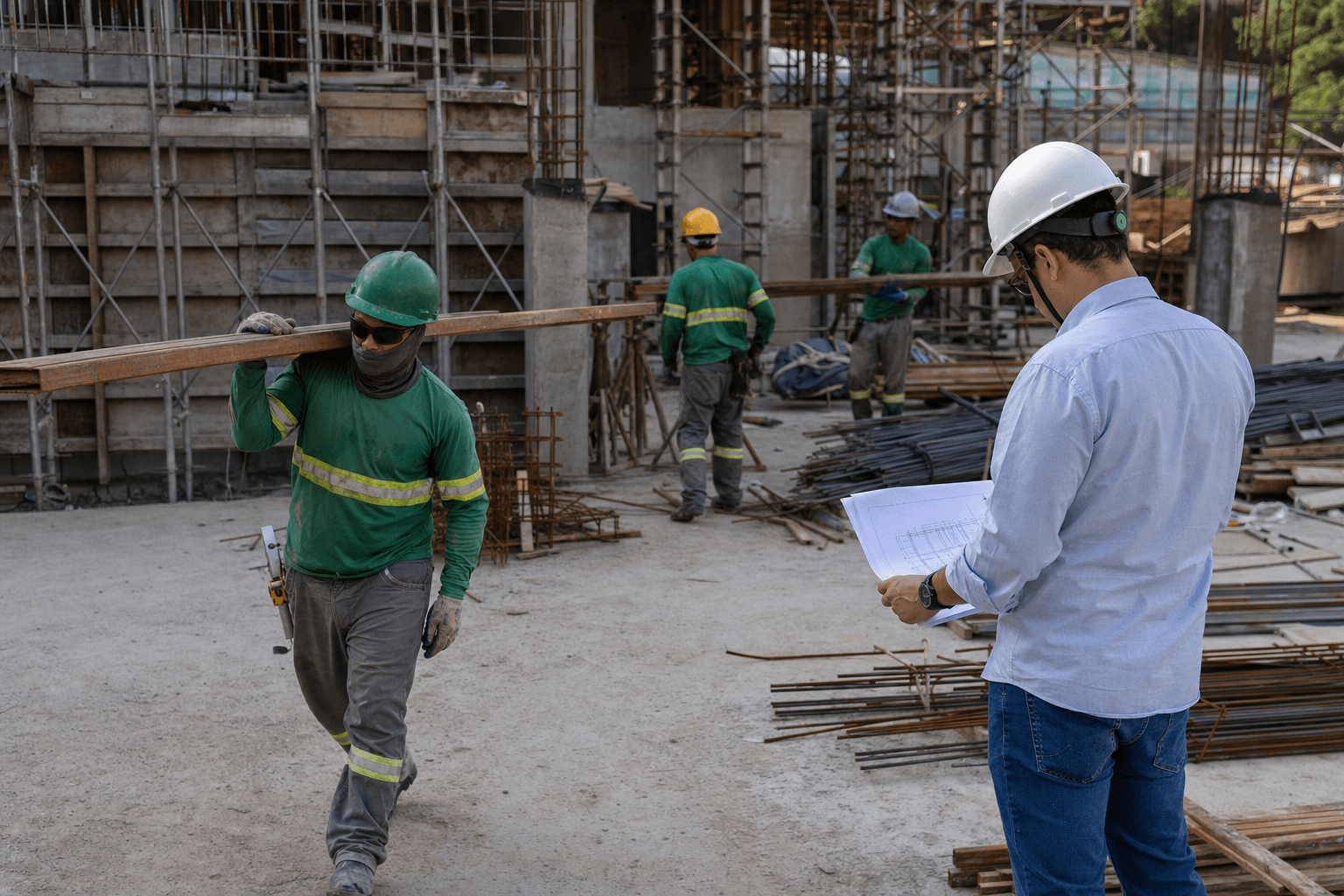
Construction led job creation in the quarterly comparison, adding 371,000 positions, a 5.1% increase, and was the only sector with a statistically relevant rise in employment over that period. Over 12 months, construction added 308,000 roles. Transport, storage and postal services added 321,000 jobs, while public administration, defence, social security, education, health and social services added 438,000. Domestic services moved in the opposite direction, losing 229,000 jobs over the year, a 4% decline.
For investors, the data point to a Brazilian economy with resilient employment and stronger aggregate income, but also a labour market where informality remains a defining feature. That mix can support consumption while complicating productivity, compliance and workforce strategy.
If you are evaluating investment, expansion or partnerships in Brazil, connect with Brazil Business Club for market intelligence, local context and introductions to the right business networks.
Doing business in Brazil?
Brazil Business Club connects investors and companies from around the world with the people and opportunities driving Brazil's economy. Tell us what you are looking for and we will help you take the next step.
Reported by the Brazil Business Club newsroom, with reference to Exame.