
Brazil’s mid month inflation cools in November as airfares and fuel offset food pressure
Brazil’s IPCA-15 rose 0.22% in November, below market forecasts, even as food prices jumped. The reading gives investors a fresh view of price dynamics in Latin America’s largest economy.
Brazil’s mid month inflation indicator came in softer than economists expected in November, offering companies and investors a more nuanced picture of demand, household costs and pricing power in Latin America’s largest economy.
The IPCA-15, widely followed as a preview of Brazil’s official consumer inflation index, rose 0.22% in November 2026, according to data released on Thursday by the Brazilian Institute of Geography and Statistics, known as IBGE. The institute is Brazil’s national statistics agency and publishes the country’s main inflation, labour and economic activity data.
In the year to date, the IPCA-15 is up 4.38%. Over 12 months, it reached 4.64%, slightly higher than the 4.62% recorded in the prior 12 month period. In November 2025, the same indicator had advanced 0.20%.
The latest number was below the consensus collected by Reuters, which had pointed to a 0.34% monthly increase and a 4.78% rise from a year earlier.
For international businesses with exposure to Brazil, the release matters because inflation data feed directly into pricing decisions, wage negotiations, consumer sentiment and expectations for monetary policy. The IPCA-15 differs from the full month IPCA mainly because of its collection period, but it is closely watched as an early signal of the official inflation trend.
Food was the main source of pressure
Five of the nine product and service groups tracked by IBGE recorded price increases in November. The most important upward force came from food and beverages, which rose 1.51% in the month.
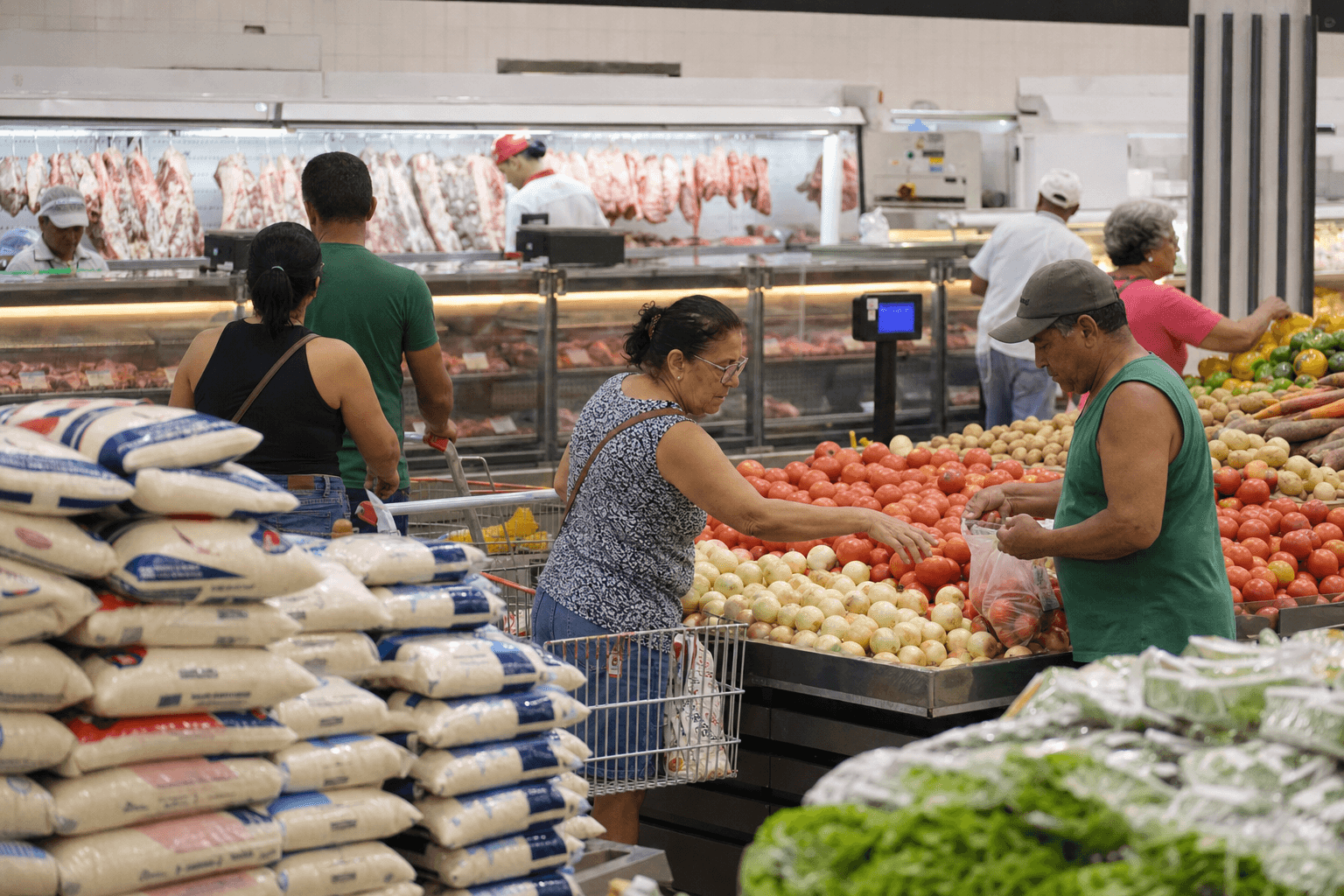
The movement was concentrated in groceries bought for home consumption. That subcategory advanced 2.02%, accelerating from 1.01% in the previous month. Several staple items posted sharp increases, including tomatoes, up 38.92%, onions, up 17.43%, meat, up 3.65%, and rice, up 3.38%.
There were some offsets within the household food basket. Potato prices fell 2.33%, while long life milk declined 1.84%.
Food consumed away from home moved in the opposite direction, easing from 0.56% in October to 0.28% in November. Snacks slowed to 0.33% from 0.66%, while restaurant meals decelerated to 0.21% from 0.61%.
That split is relevant for consumer companies. Grocery inflation can squeeze household budgets quickly, particularly for lower income consumers, while softer increases in meals and snacks may indicate more limited room for restaurants and food service operators to pass on costs.
Communications and personal expenses also rose
Beyond food, communications and personal expenses were among the groups that pushed the index higher.
Communications rose 0.88%, reflecting increases in internet access, up 2.26%, and mobile phone plans, up 1.71%. The category is important for telecom operators and digital service providers because connectivity spending has become a core household expense across Brazil.
Personal expenses increased 0.49%. Within that group, travel packages rose 3.79%, accommodation gained 1.63%, and domestic employee services increased 0.62%.
For tourism, hospitality and service sector investors, the details point to pockets of price resilience, even as the headline inflation figure stayed below expectations.
Transport and housing helped contain the headline number
The biggest disinflationary contribution came from transport, where prices fell 0.71%. Airfares dropped 9.57%, producing the largest negative impact on the monthly index, at 0.07 percentage point.
Fuel prices also declined, down 0.95% overall. Gasoline fell 1.23%, helping reduce pressure on consumers and logistics costs. Other fuels moved higher, however, with vehicular gas up 1.06%, ethanol up 0.76%, and diesel up 0.09%.
Health and personal care fell 0.28%, influenced by a 1.22% decline in personal hygiene products. Perfume prices, for example, dropped 2.35%.
Housing prices decreased 0.14%. Residential electricity was down 0.85%, with Brazil’s green tariff flag remaining in effect in November, meaning consumers faced no additional charge on power bills. Brazil uses a colour coded electricity tariff flag system to reflect generation conditions and costs.
IBGE also noted local tariff adjustments that affected regional readings, including electricity changes of 7.02% in Goiânia and 0.92% in Brasília from October 22, and 1.98% at one utility in São Paulo from October 23. Piped gas rose 0.32%, including an average adjustment of 2.20% in Rio de Janeiro from November 1. Water and sewage fees fell 0.96%, partly due to a 25% discount on the minimum tariff in Curitiba from October 1.
For investors, the November IPCA-15 reading suggests that Brazil’s inflation picture remains uneven. Food is still applying pressure, but transport, energy related items and selected services helped keep the headline figure lower than expected.
If you are evaluating investment opportunities, market entry or partnerships in Brazil, connect with Brazil Business Club for local insight and practical support.
Doing business in Brazil?
Brazil Business Club connects investors and companies from around the world with the people and opportunities driving Brazil's economy. Tell us what you are looking for and we will help you take the next step.
Reported by the Brazil Business Club newsroom, with reference to InfoMoney.