
Brazil’s July inflation cools to 0.07% as food prices fall
Brazil’s official inflation index slowed in July, with cheaper groceries and fuel offsetting a sharp rise in residential electricity bills. The 12-month rate still stands above the Central Bank’s target ceiling.
Brazil’s official inflation gauge lost momentum in July, offering some relief to households even as power bills kept pressure on monthly prices.
The IPCA, the Broad National Consumer Price Index and Brazil’s main inflation benchmark, rose 0.07% in July, according to figures released on Tuesday, August 11, by IBGE, the national statistics institute. That was down from 0.16% in June, although it came in slightly above the 0.03% increase expected by financial market analysts.
Inflation has now accumulated 3.44% in 2026. Over 12 months, the IPCA is up 4.44%, still above the upper limit of the Central Bank of Brazil’s inflation target range. In July 2025, the monthly reading had been 0.26%.
The headline number concealed a sharp split inside the consumer basket. Housing costs rose strongly, led by electricity tariffs. Food and beverages moved in the opposite direction, with steep declines in several staples bought for home consumption.
Electricity offset by cheaper food
The housing group rose 0.99% in July and added 0.15 percentage point to the overall IPCA. Food and beverages fell 0.67%, subtracting 0.14 percentage point. In practical terms, lower food prices almost neutralised the inflationary impact from housing.
Residential electricity was the single largest upward influence on the index. Bills increased 3.09% in July, after a 1.53% rise in June, contributing 0.13 percentage point to the month’s IPCA.
The increase reflected tariff adjustments in areas covered by the IBGE survey. A utility in São Paulo raised rates by 8.85% from July 4. Adjustments that began in June also entered the calculation, including increases of 14.89% at a utility in Porto Alegre and 19.55% in Curitiba.
Brazil’s yellow tariff flag also remained in force in July. The system adds an extra charge to power bills when electricity generation conditions are less favourable. In this case, the surcharge was R$1.885 for every 100 kilowatt-hours consumed.
Water and sewage fees also rose, increasing 0.40% after tariff changes in cities including Salvador, Porto Alegre, Brasília and Rio Branco.
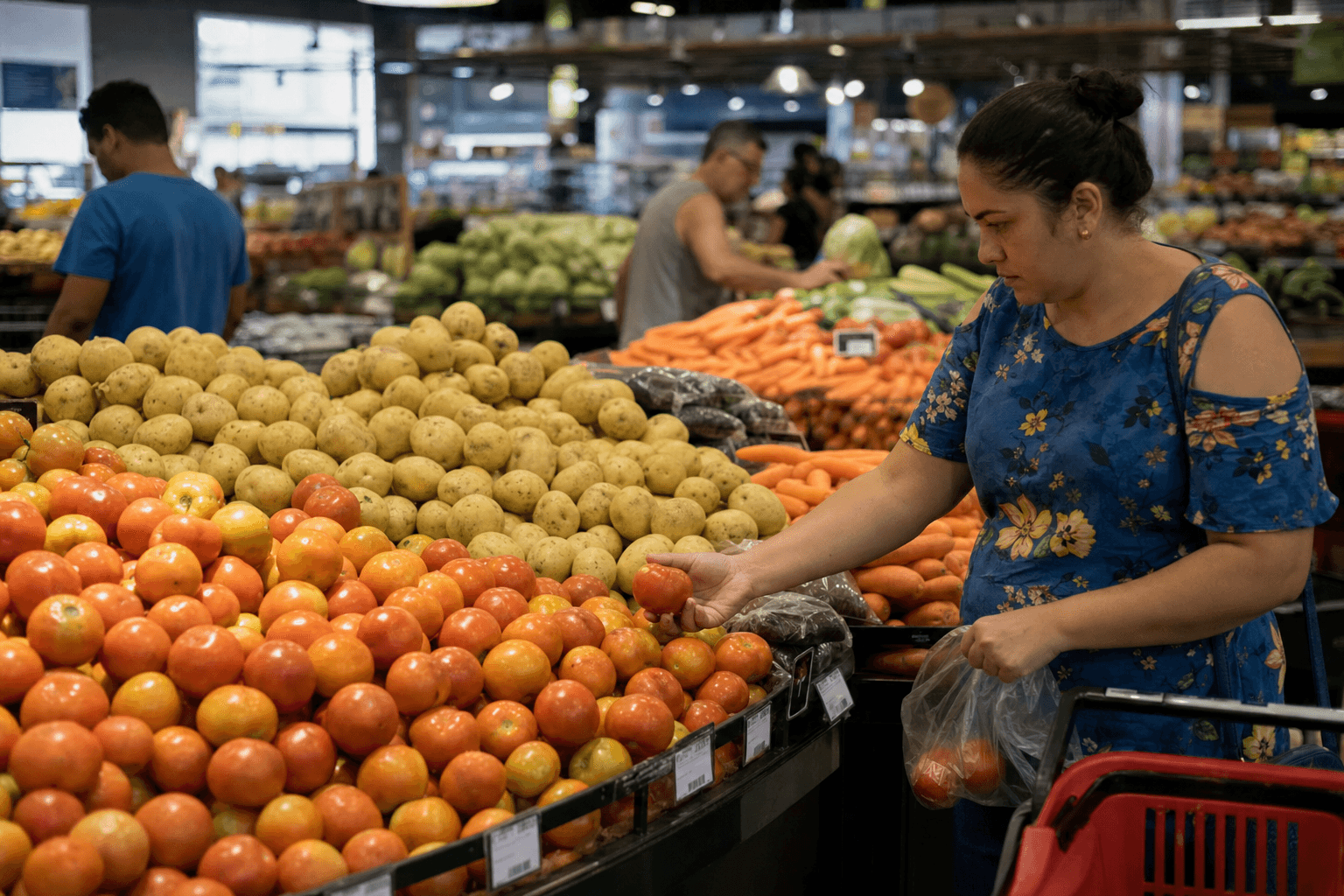
Food offered the main counterweight. Prices for food consumed at home dropped 1.14%, led by some of the most visible items in Brazilian shopping baskets. Tomatoes fell 29.09%, the largest individual downward impact on July inflation, removing 0.10 percentage point from the IPCA. Potatoes declined 19.59%, while carrots were 14.41% cheaper.
Ground coffee also fell, by 2.45%. Not all grocery items followed the same path, however. Long-life milk rose 2.47%, and fruit prices advanced 1.20%.
Transport and regions show uneven picture
The relief at supermarkets did not extend to restaurants and snack bars. Food consumed away from home rose 0.55% in July, accelerating from 0.15% in June. Snacks went from a 0.13% rise to 0.76%, while meals increased 0.42%, compared with 0.15% the previous month.
Transport prices were almost flat overall, rising just 0.05%, despite an 11.67% jump in airfares. Fuel prices helped keep the group contained, with the category falling 1.44% in the month.
All fuel types surveyed by IBGE declined. Ethanol was down 2.26%, gasoline fell 1.37%, diesel dropped 1.22%, and vehicular gas slipped 0.08%.
Health and personal care rose 0.40%, with personal hygiene products up 0.64% and health plans up 0.42%. Clothing moved lower, falling 0.66% after a 0.17% increase in June. Household goods rose 0.07%, education declined 0.03%, and communication services advanced 0.04%.
Regional data also showed a divided picture. Rio Branco recorded the highest inflation among the surveyed areas, at 0.32%, influenced by airfares and residential electricity. Belém had the lowest result, with deflation of 0.45%, helped by a 3.42% fall in gasoline and a 14.24% decline in açaí prices.
What this means for Brazil investors
July’s inflation report gives a nuanced signal rather than a clean turning point. The monthly index slowed, and the declines in food and fuel prices are positive for household purchasing power. At the same time, electricity costs remain a reminder that regulated prices can quickly alter the inflation picture.
For companies operating in Brazil, the data matters well beyond macroeconomic headlines. Food prices affect consumer demand, fuel costs influence logistics, and electricity tariffs shape margins across industry, retail and services. With 12-month inflation still above the Central Bank’s target ceiling, price dynamics remain central to planning, investment decisions and market entry strategies.
Brazil Business Club helps investors and companies interpret these shifts and connect them to real opportunities on the ground. If you are looking to invest in Brazil, expand operations or better understand the country’s business environment, connect with the club to explore the next step.
Doing business in Brazil?
Brazil Business Club connects investors and companies from around the world with the people and opportunities driving Brazil's economy. Tell us what you are looking for and we will help you take the next step.
Reported by the Brazil Business Club newsroom, with reference to Exame.