
Brazil puts critical minerals at the centre of its industrial strategy
President Luiz Inácio Lula da Silva has approved a new national policy for critical and strategic minerals, with up to BRL 7 billion in incentives for research, extraction and processing. The move signals a push to keep more value from rare earths and other inputs inside Brazil.
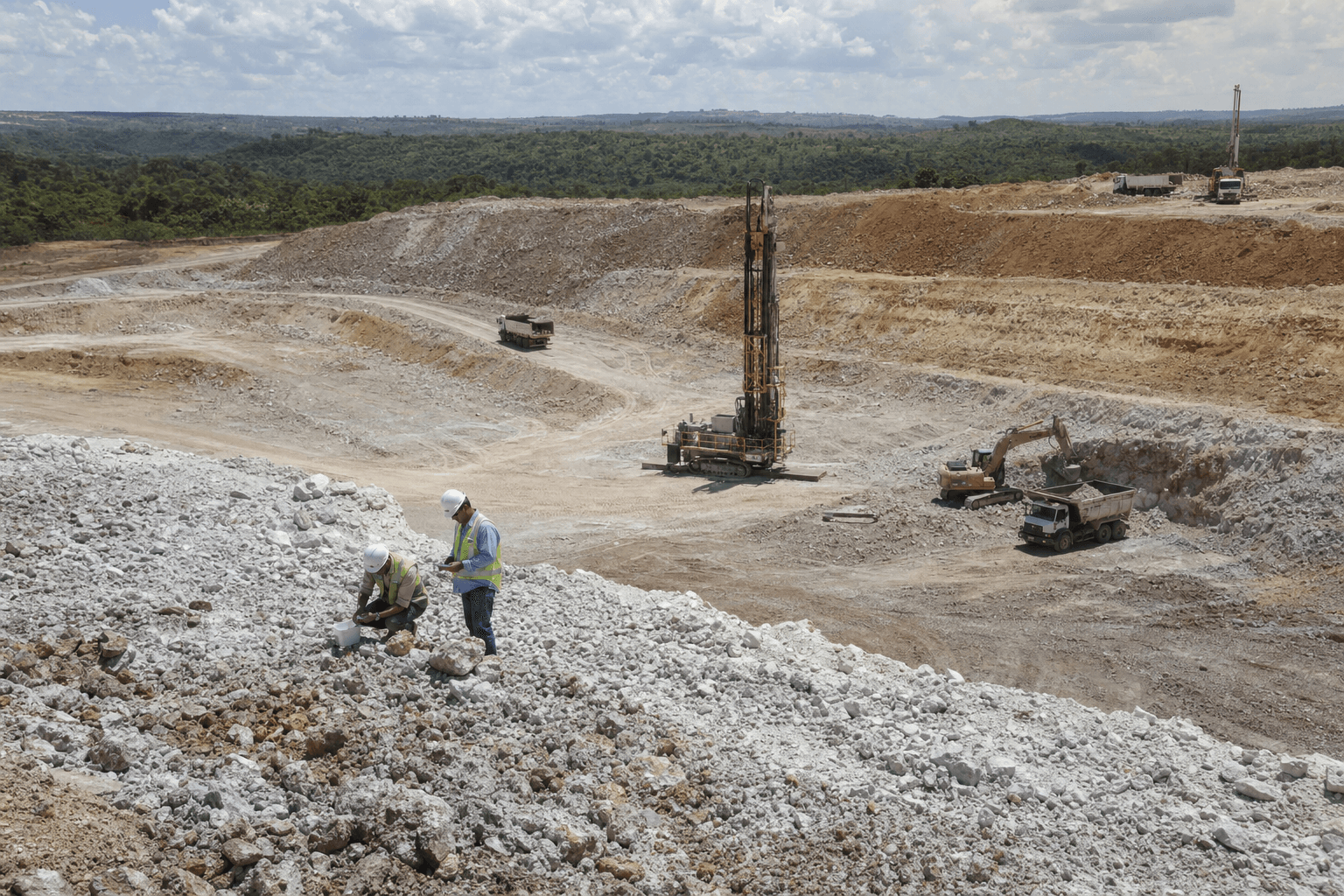
Brazil has moved to formalise its ambitions in critical minerals, a sector increasingly tied to electric vehicles, wind power, electronics, defence systems and the geopolitics of supply chains.
President Luiz Inácio Lula da Silva signed a law on Wednesday, September 16, creating the National Policy on Critical and Strategic Minerals. The framework provides for up to BRL 7 billion in investment incentives for projects covering geological research, extraction and mineral processing.
For international companies, the measure is important not only because of the headline funding. It also points to a more interventionist industrial policy in a country that holds large reserves but wants to avoid remaining only a supplier of unprocessed raw materials.
Policy design and financing
A central instrument in the new law is the Mineral Activity Guarantee Fund, known by its Portuguese acronym FGAM. The fund will receive BRL 2 billion from the federal government and is intended to support projects and activities linked to the production of critical and strategic minerals.
Access will not be automatic. According to the law, FGAM resources may only back projects classified as priorities under the national policy. For investors, that makes project selection, regulatory alignment and early engagement with public authorities especially relevant.
Pablo Cesário, of the Brazilian Mining Institute, said the sector needs a stable operating environment because of its long investment horizon. "Mining requires intensive investment and production cycles that often span 40 years. Therefore, predictability and stability, especially fiscal stability, are vital to attracting long-term investment," he said.
The government is also increasing support for geological knowledge. Mines and Energy Minister Alexandre Silveira said the Geological Service of Brazil will have its budget raised from BRL 8 million to BRL 300 million to finance soil research. For readers outside Brazil, the Geological Service is the federal body responsible for geological mapping and related technical work, a core function in reducing uncertainty for exploration projects.
Silveira said the policy should help the country understand its mineral base more fully while retaining control over strategic decisions. Brazil, he said, will gain deeper knowledge of its resources and "preserve its decision-making authority over its production chains."
Sovereignty and local value chains
Lula framed the new policy in explicitly industrial and sovereignty-oriented terms. After signing the law, he called for investment in training professionals for a market expected to grow and invited universities and federal institutes to help create new degree programmes.
The president said Brazil should aim to be globally competitive in skills formation, stating that the country should not be "second to anyone in the world in terms of training."
His remarks also made clear that Brasília wants mining to be connected to domestic processing, refining and technology development. Lula criticised those who, in his words, wanted to sell critical minerals in raw form to the United States "for a song, just as they did with iron ore."
"We will not allow history to repeat itself. Let Brazil's enemies understand once and for all, our sovereignty is not for sale. Brazil's wealth has only one owner, the Brazilian people," he said.
The same day, Lula signed a decree creating the National Council for the Industrialization of Critical and Strategic Minerals. The council will coordinate, plan and monitor the national policy. It will also propose public policies and actions to develop supply chains around minerals considered critical or strategic.
For foreign businesses, this signals opportunity but also a likely preference for projects that include local value addition, technology transfer, workforce development or downstream industrial links.
Why investors are watching
Critical minerals are commonly defined as minerals whose supply carries risks. Those risks can include geographic concentration of production, reliance on foreign suppliers, geopolitical instability, technological barriers, supply disruptions and the lack of practical substitutes.
Rare earth elements are a specific group within this broader universe. They comprise 17 chemical elements dispersed in nature, which makes extraction technically difficult. They are used in wind turbines, smartphones, electric cars and defence systems.
Brazil is already significant on paper. The country has approximately 21 million metric tons of rare earth reserves, the second largest mapped reserve base in the world after China, which has approximately 44 million metric tons. Yet only about 25 percent of Brazilian territory has been mapped, leaving substantial geological potential still to be assessed.
The strategic label is not fixed. Each country defines critical and strategic minerals according to its own industrial needs and supply vulnerabilities. Lists can change as technologies evolve, new deposits are discovered, geopolitical conditions shift and demand patterns move.
For investors, Brazil's new policy creates a clearer public signal around mining, processing and industrialisation. The practical test will be how priority projects are selected, how quickly funding mechanisms become operational, and whether fiscal and licensing conditions deliver the predictability that long-cycle mineral projects require.
Companies looking at Brazil's critical minerals sector should watch the implementation rules, the first FGAM-backed projects and the agenda of the new national council. If you are planning to invest in or do business with Brazil, connect with Brazil Business Club to understand the market, policy landscape and partnership opportunities.
Doing business in Brazil?
Brazil Business Club connects investors and companies from around the world with the people and opportunities driving Brazil's economy. Tell us what you are looking for and we will help you take the next step.
Reported by the Brazil Business Club newsroom, with reference to Agência Brasil.