
Brazil awards seven pre-salt oil blocks in largest offshore sharing auction
Petrobras, Prio, Equinor, CNOOC, Sinopec and Galp secured areas in the Santos and Campos basins, generating BRL 530 million in signing bonuses. The result expands Brazil’s production-sharing exploration acreage by 58 percent.
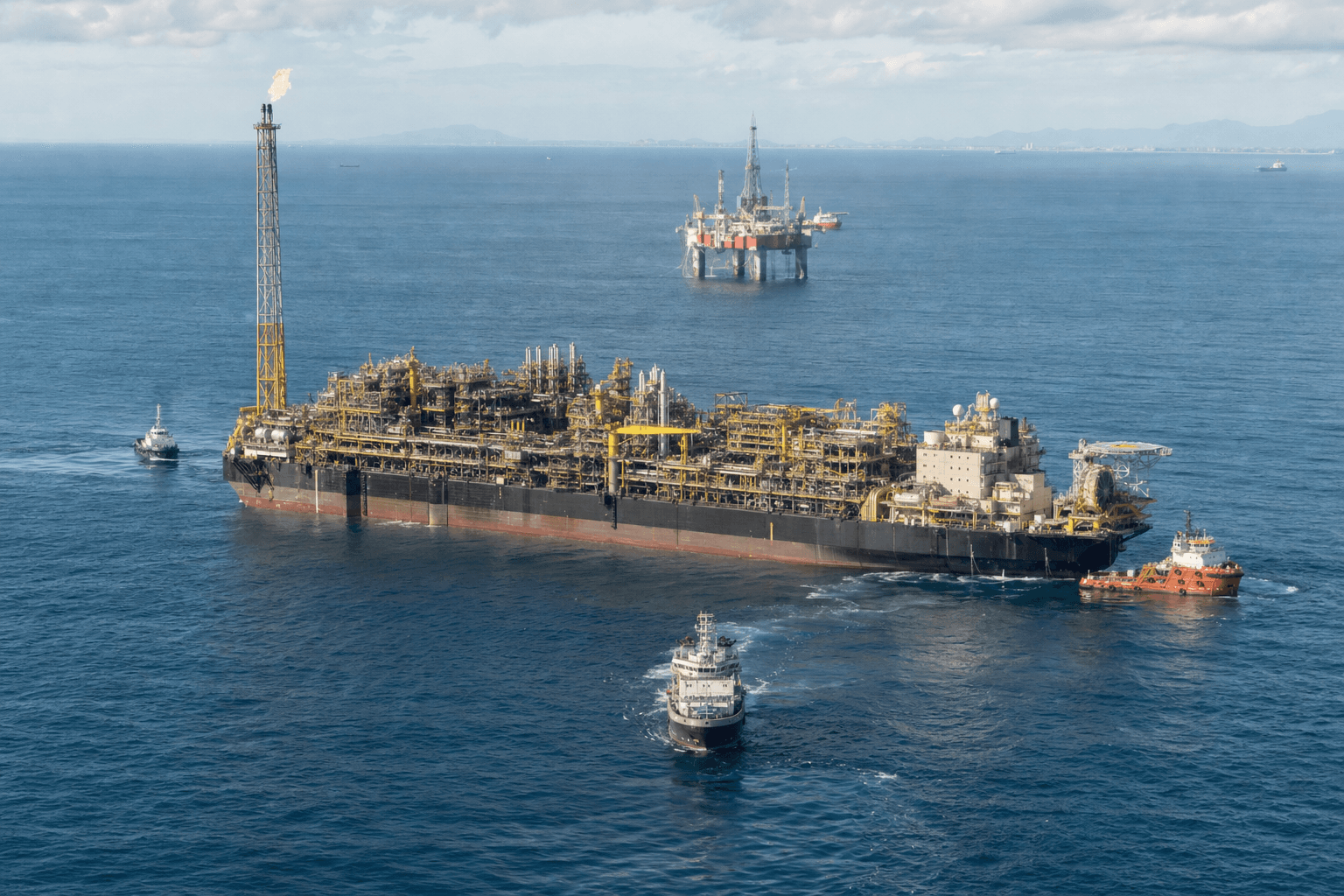
Brazil’s latest pre-salt oil auction handed exploration rights to seven of 13 offshore blocks, reinforcing the country’s position as one of the world’s most closely watched deepwater investment markets.
The 4th Cycle of the Permanent Production-Sharing Offer was held on Wednesday, October 7, at the Rio de Janeiro headquarters of ANP, Brazil’s national oil, gas and biofuels regulator. The auction will bring BRL 530 million in signing bonuses to the federal government. If every block had been sold, the total would have reached BRL 1.24 billion.
For international energy companies, the result was mixed. Brazil succeeded in allocating more pre-salt acreage than in any previous auction of this type, but demand was selective. Nineteen companies were qualified to participate, yet only six submitted offers, four of them foreign. None of the awarded blocks drew competing bids.
Even so, the sale expands the area under Brazil’s production-sharing regime by 58 percent to 39,200 square kilometres. That is roughly 90 percent of the area of Rio de Janeiro state, which covers 43,800 square kilometres.
Petrobras, Prio and Equinor lead the winners
The blocks are located in the Santos and Campos basins off Brazil’s southeastern coast, the heart of the country’s offshore oil industry.
Brazilian companies Petrobras and Prio, formerly PetroRio, were the most active winners, each taking two blocks. Norway’s Equinor also secured two, including one in partnership with Portugal’s Galp.
Prio won the Magnetite block with an offer of 32.80 percent of surplus oil, a premium of 132.79 percent over the minimum required, and the Hematite block with 7.18 percent, a 315.03 percent premium.
Petrobras took Azurite with 30 percent of surplus oil, a 139.81 percent premium, and Cruzeiro do Sul with 15.27 percent, an 8.07 percent premium.
A Chinese consortium won Jade, with CNOOC holding 70 percent and Sinopec 30 percent. The group offered 18.20 percent of surplus oil, a premium of 65.76 percent.
Equinor won Ruby with 25.02 percent, a 91.72 percent premium. It also secured Rhodochrosite in a consortium with Galp, where Equinor holds 70 percent and Galp 30 percent. That offer was 15.52 percent of surplus oil, the highest premium of the round at 494.64 percent.
Across the seven awarded areas, companies committed to minimum investments of about BRL 778.4 million. The average premium was 108.38 percent.
Six areas were not awarded: Tourmaline, Larimar, Aragonite, Opal, Garnet and Cerussite. They will be moved into a future bidding round.
How Brazil’s production-sharing model works
Brazil uses different contractual models for oil exploration. In the production-sharing system used for these pre-salt areas, the winning bidder is the company or consortium that offers the federal government the largest share of surplus oil. Surplus oil is the production left after recoverable costs are deducted.
ANP sets the signing bonus and minimum investment requirements in the tender documents. The Ministry of Mines and Energy approved the areas, and the Ministry of the Environment and Climate Change also gave clearance.
The bidding process is confidential. Companies do not know which areas competitors will target or what percentage of surplus oil they will offer. That helps explain why blocks can be awarded at premiums even without head-to-head bidding during the public session.
Winning companies must now complete the remaining formal steps, including submitting documentation and paying the signing bonuses. Contract signing is scheduled for February 26, 2027.
Why the pre-salt still matters for investors
The pre-salt is a deep geological formation under a thick salt layer, with reservoirs that can lie at depths of up to 7,000 metres. It is Brazil’s main oil and gas production province. In September, it accounted for 82.6 percent of national output.
Before the auction, ANP Director-General Artur Watt Neto described the pre-salt as “one of the most significant exploration frontiers in the world.” He said Brazil must keep offering blocks close to identified opportunities, calling the region “a great source of wealth for the country.”
Renato Dutra, the National Secretary for Oil, Natural Gas and Biofuels at the Ministry of Mines and Energy, said oil strengthens Brazil’s international position. He added that the ministry is working with environmental authorities to expand the supply of exploration acreage and “preserve national energy security.”
The government is also preparing to offer more than 50 exploration blocks in the Pelotas Basin, off Brazil’s southern coast. Officials see the area as promising because of geological similarities with oil-producing areas off Africa.
Dutra also reiterated government interest in unconventional exploration, including fracking. The technique, which uses pressurised water, sand and chemical additives to fracture rock formations, faces opposition from environmental groups and is under review in a case before Brazil’s Superior Court of Justice.
For investors, the auction confirms both the appeal and the complexity of Brazil’s upstream sector: world-class reserves, large capital requirements, active state participation and rising environmental scrutiny. Companies assessing entry or expansion should monitor the contract awards, the next pre-salt round and the Pelotas Basin pipeline.
If your company is evaluating investment, partnerships or market entry in Brazil’s energy sector, connect with Brazil Business Club for informed guidance and local business access.
Doing business in Brazil?
Brazil Business Club connects investors and companies from around the world with the people and opportunities driving Brazil's economy. Tell us what you are looking for and we will help you take the next step.
Reported by the Brazil Business Club newsroom, with reference to Agência Brasil.